albtechportal

  • Subscribe to our RSS feed.
  • Twitter
  • StumbleUpon
  • Reddit
  • Facebook
  • Digg

Monday, 7 October 2013

Windows Server 2012

Posted on 07:53 by Unknown
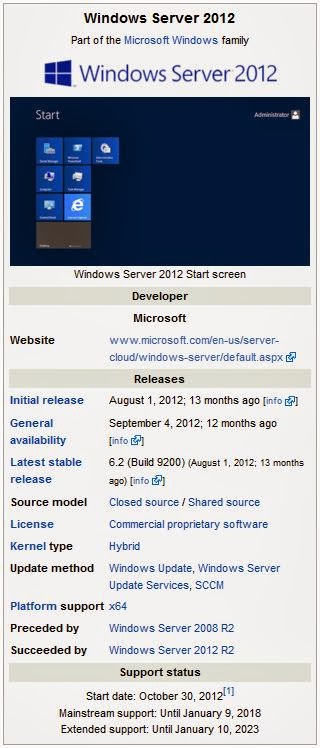
Windows Server 2012, codenamed "Windows Server 8",[2] is the sixth release of Windows Server. It is the server version of Windows 8 and succeeds Windows Server 2008 R2. Two pre-release versions, a developer preview and a beta version, were released during development. The software was generally available to customers starting on September 4, 2012.[3]
Unlike its predecessor, Windows Server 2012 has no support for Itanium-based computers,[4] and has four editions. Various features were added or improved over Windows Server 2008 R2 (with many placing an emphasis on cloud computing), such as an updated version of Hyper-V, an IP address management role, a new version of Windows Task Manager, and ReFS, a new file system. Windows Server 2012 received generally good reviews in spite of having included the same controversial Metro-based user interface seen in Windows 8.

History

Windows Server 2012, codenamed "Windows Server 8",[2] is the sixth release of Windows Server family of operating systems developed concurrently with Windows 8.[5][6] It was not until 17 April 2012 that the company announced that the final product name would be "Windows Server 2012".[2]
Microsoft introduced Windows Server 2012 and its developer preview in the BUILD 2011 conference on 9 September 2011.[7] However, unlike Windows 8, the developer preview of Windows Server 2012 was only made available to MSDN subscribers.[8] It included a graphical user interface (GUI) based on Metro design language and a new Server Manager, a graphical application used for server management.[9] On 16 February 2012, Microsoft released an update for developer preview build that extended its expiry date from 8 April 2012 to 15 January 2013.[10]
Before Windows Server 2012 was finalized, two test builds were made public. A public beta version of Windows Server 2012 was released along with the Windows 8 Consumer Preview on 29 February 2012.[5] The release candidate of Windows Server 2012 was released on 31 May 2012, along with the Windows 8 Release Preview.[6]
The product was released to manufacturing on 1 August 2012 and became generally available on 4 September 2012.[3] However, not all editions of Windows Server 2012 were released at the same time. Windows Server 2012 Essentials was released to manufacturing on 9 October 2012[11] and was made generally available on 1 November 2012.[12] As of 23 September 2012, all students subscribed to DreamSpark program can download Windows Server 2012 Standard or Datacenter free of charge.[13]

Features

Installation options

Unlike its predecessor, Windows Server 2012 can switch between "Server Core" and "Server with a GUI" installation options without a full reinstallation. Server Core - an option with a command-line interface only - is now the recommended configuration. There is also a third installation option that allows some GUI elements such as MMC and Server Manager to run, but without the normal desktop, shell or default programs like File Explorer.[9]

User interface

Server Manager has been redesigned with an emphasis on easing management of multiple servers.[14] The operating system, like Windows 8, uses the Metro UI unless installed in Server Core mode.[15] Windows PowerShell in this version has over 2300 commandlets, compared to around 200 in Windows Server 2008 R2.[16]

Task Manager

Main article: Windows Task Manager
Windows Server 2012 includes a new version of Windows Task Manager together with the old version.[17] In the new version the tabs are hidden by default showing applications only. In the new Processes tab, the processes are displayed in varying shades of yellow, with darker shades representing heavier resource use.[18] It lists application names and status, as well as CPU, memory, hard disk and network utilization. The process information found in the older versions are now moved to the new Details tab. The Performance tab shows "CPU", "Memory", "Disk", "Wi-Fi" and "Ethernet" graphs. The CPU tab no longer displays individual graphs for every logical processor on the system by default; instead, it can display data for each NUMA node. When displaying data for each logical processor for machines with more than 64 logical processors, the CPU tab now displays simple utilization percentages on heat-mapping tiles.[19] The color used for these heat maps is blue, with darker shades again indicating heavier utilization. Hovering the cursor over any logical processor's data now shows the NUMA node of that processor and its ID, if applicable. Additionally, a new Startup tab has been added that lists startup applications,[20] however this tab does not exist in Windows Server 2012.[21] The new task manager recognizes when a Windows Store app has the "Suspended" status.

IP address management (IPAM)

Windows Server 2012 has an IP address management role for discovering, monitoring, auditing, and managing the IP address space used on a corporate network. The IPAM is used for the management and monitoring of Domain Name System (DNS) and Dynamic Host Configuration Protocol (DHCP) servers. Both IPv4 and IPv6 are fully supported.[22]

Active Directory

Windows Server 2012 has a number of changes to Active Directory from the version shipped with Windows Server 2008 R2. The Active Directory Domain Services installation wizard has been replaced by a new section in Server Manager, and a GUI has been added to the Active Directory Recycle Bin.[23] Multiple password policies can be set in the same domain.[24] Active Directory in Windows Server 2012 is now aware of any changes resulting from virtualization, and virtualized domain controllers can be safely cloned. Upgrades of the domain functional level to Windows Server 2012 are simplified; it can be performed entirely in Server Manager. Active Directory Federation Services is no longer required to be downloaded when installed as a role, and claims which can be used by the Active Directory Federation Services have been introduced into the Kerberos token. Windows Powershell commands used by Active Directory Administrative Center can be viewed in a "Powershell History Viewer".[25][26]

Hyper-V

Windows Server 2012, along with Windows 8, includes a new version of Hyper-V,[27] as presented at the Microsoft BUILD event.[28] Many new features have been added to Hyper-V, including network virtualization, multi-tenancy, storage resource pools, cross-premise connectivity, and cloud backup. Additionally, many of the former restrictions on resource consumption have been greatly lifted. Each virtual machine in this version of Hyper-V can access up to 64 virtual processors, up to 1 terabyte of memory, and up to 64 terabytes of virtual disk space per virtual hard disk (using a new .vhdx format).[29][30] Up to 1024 virtual machines can be active per host, and up to 8000 can be active per failover cluster.[31] SLAT is a required processor feature for Hyper-V on Windows 8, while for Windows Server 2012 it is only required for the supplementary RemoteFX role.[32]

ReFS

Main article: ReFS
Resilient File System (ReFS),[33] codenamed "Protogon",[34] is a new file system in Windows Server 2012 initially intended for file servers that improves on NTFS in some respects. Major new features of ReFS include:[35][36]
Improved reliability for on-disk structures
ReFS uses B+ trees[35] for all on-disk structures including metadata and file data. Metadata and file data are organized into tables similar to a relational database. The file size, number of files in a folder, total volume size and number of folders in a volume are limited by 64-bit numbers; as a result ReFS supports a maximum file size of 16 Exabytes, a maximum of 18.4 × 10¹⁸ folders and a maximum volume size of 1 Yottabyte (with 64 KB clusters) which allows large scalability with no practical limits on file and folder size (hardware restrictions still apply). Free space is counted by a hierarchical allocator which includes three separate tables for large, medium, and small chunks. File names and file paths are each limited to a 32 KB Unicode text string.
Built-in resilience
ReFS employs an allocation-on-write update strategy for metadata,[35] which allocates new chunks for every update transaction and uses large IO batches. All ReFS metadata has built-in 64-bit checksums which are stored independently. The file data can have an optional checksum in a separate "integrity stream", in which case the file update strategy also implements allocation-on-write; this is controlled by a new "integrity" attribute applicable to both files and directories. If nevertheless file data or metadata becomes corrupt, the file can be deleted without taking down the whole volume offline for maintenance, then restored from the backup. As a result of built-in resiliency, administrators do not need to periodically run error-checking tools such as CHKDSK when using ReFS.
Compatibility with existing APIs and technologies
ReFS does not require new system APIs and most file system filters continue to work with ReFS volumes.[35] ReFS supports many existing Windows and NTFS features such as BitLocker encryption, Access Control Lists, USN Journal, change notifications,[37] symbolic links, junction points, mount points, reparse points, volume snapshots, file IDs, and oplock. ReFS seamlessly[35] integrates with Storage Spaces, a storage virtualization layer that allows data mirroring and striping, as well as sharing storage pools between machines.[38] ReFS resiliency features enhance the mirroring feature provided by Storage Spaces and can detect whether any mirrored copies of files become corrupt using background data scrubbing process, which periodically reads all mirror copies and verifies their checksums then replaces bad copies with good ones.
Some NTFS features are not supported in ReFS, including named streams, object IDs, short names, file compression, file level encryption (EFS), user data transactions, hard links, extended attributes, and disk quotas.[35][34] Sparse files was not supported by Preview, but it is supported by RTM.[39][40] ReFS does not itself offer data deduplication.[35] Dynamic disks with mirrored or striped volumes are replaced with mirrored or striped storage pools provided by Storage Spaces. However, in Windows Server 2012, automated error-correction is only supported on mirrored spaces, and booting from ReFS is not supported either.

IIS 8.0

Windows Server 2012 includes version 8.0 of Internet Information Services (IIS). The new version contains new features such as SNI, CPU usage caps for particular websites,[41] centralized management of SSL certificates, WebSocket support and improved support for NUMA, but few other substantial changes were made.[42]

Scalability

Windows Server 2012 supports the following maximum hardware specifications.[43][30] Windows Server 2012 improves over its predecessor Windows Server 2008 R2:


System requirements
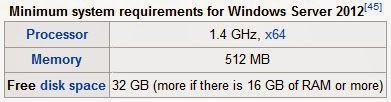


Windows Server 2012 runs only on x64 processors. Unlike its predecessor, Windows Server 2012 does not support Itanium.[4]Upgrades from Windows Server 2008 and Windows Server 2008 R2 are supported, though upgrades from prior releases are not.[45]

Editions

Windows Server 2012 has four editions: Foundation, Essentials, Standard and Datacenter.


Reception

Reviews of Windows Server 2012 have been generally positive.[51][52][53] Simon Bisson of ZDnet described it as "ready for the datacentre, today,"[51] while Tim Anderson of The Register said that "The move towards greater modularity, stronger automation and improved virtualisation makes perfect sense in a world of public and private clouds" but remarked that "That said, the capability of Windows to deliver obscure and time-consuming errors is unchanged" and concluded that "Nevertheless, this is a strong upgrade overall."[52] InfoWorld noted that Windows Server 2012 has the Metro UI, which had led to mixed reviews for Windows 8, but mentioned that "Microsoft is pushing harder for a GUI-less install than a Metro-based screen", with reference to the improved Server Core installation option and the improvements for Windows PowerShell.[54] However, Michael Otey of Windows IT Pro expressed dislike with the new Metro interface and the lack of ability to use the older desktop interface alone, saying that most users of Windows Server manage their servers using the graphical user interface rather than PowerShell.[55] The Australian construction company Kennards found the OS stable.[56]
Paul Ferrill wrote that "Windows Server 2012 Essentials provides all the pieces necessary to provide centralized file storage, client backups, and remote access,"[57] but Tim Anderson contended that "Many businesses that are using SBS2011 and earlier will want to stick with what they have", citing the absence of Exchange, the lack of ability to synchronize with Active Directory Federation Services and the 25-user limit,[58] while Paul Thurott wrote "you should choose Foundation only if you have at least some in-company IT staff and/or are comfortable outsourcing management to a Microsoft partner or solution provider" and "Essentials is, in my mind, ideal for any modern startup of just a few people."[59]

Windows Server 2012 R2

Windows Server 2012 R2 is the next version of Windows Server. It was unveiled on June 3, 2013 at TechEd North America,[60] with a preview release on June 24, 2013.[61] According to Windows Server 2012 R2 datasheet published on May 31, 2013, there will be three editions of this operating system: Essentials, Standard and Datacenter.[62]As with Windows Server 2012, the Datacenter and Standard editions are feature identical, varying only based on licensing (particularly licensing of Hyper-V VMs). The Essentials edition has the same features as the Datacenter and Standard products, with some restrictions.[63]

Changes from Windows Server 2012

Microsoft has confirmed the following changes introduced by Windows Server 2012 R2:
  • Automated Tiering: Storage Spaces stores most frequently accessed files on fastest physical media[64]
  • Deduplication for VHD: Reduces the storage space for VHD files with largely similar contents by storing the similar contents only once[64]
  • Windows PowerShell v4, which now includes a Desired State Configuration (DSC) feature
  • Integrated Office 365 support
  • Return of the Windows Start button[65]
  • UEFI-based virtual machines
  • Upgrades from driver emulators to synthetic hardware drivers to minimize legacy support
  • Boot from SCSI
  • Faster VM deployment (approximately half the time)[66]
  • IIS 8.5, which includes several performance and logging enhancements[66]                       
  •  
    Source : Wikipedia.org
Read More
Posted in Microsoft, Server2012 | No comments

Windows Server 2008

Posted on 07:44 by Unknown
Windows Server 2008 (sometimes abbreviated as "Win2K8"[2]or "W2K8") is one of Microsoft Windows' server line of operating systems. Released to manufacturing on February 4, 2008, and officially released on February 27, 2008, it is the successor to Windows Server 2003, released nearly five years earlier. A second release, named Windows Server 2008 R2, was released to manufacturing on July 22, 2009.[3]Like Windows Vista and Windows 7, Windows Server 2008 is based on Windows NT6.x.

History

Originally known as Windows Server Codename "Longhorn", Microsoftchairman Bill Gates announced its official title (Windows Server 2008) during his keynote address at WinHEC16 May 2007.[4]
Beta 1 was released on 27 July 2005, Beta 2 was announced and released on 23 May 2006 at WinHEC 2006 and Beta 3 was released publicly on 25 April 2007.[5]Release Candidate 0 was released to the general public on 24 September 2007[6]and Release Candidate 1 was released to the general public on 5 December 2007. Windows Server 2008 was released to manufacturing on 4 February 2008 and officially launched on 27 February 2008.[7]

Features

See also: Features new to Windows Vista
Windows Server 2008 is built from the same code base as Windows Vista; therefore, it shares much of the same architecture and functionality. Since the code base is common, it automatically comes with most of the technical, security, management and administrative features new to Windows Vista such as the rewritten networking stack(native IPv6, native wireless, speed and security improvements); improved image-based installation, deployment and recovery; improved diagnostics, monitoring, event logging and reporting tools; new security features such as BitLocker and ASLR(address space layout randomization); improved Windows Firewall with secure default configuration; .NET Framework 3.0technologies, specifically Windows Communication Foundation, Microsoft Message Queuing and Windows Workflow Foundation; and the core kernel, memory and file system improvements. Processors and memory devices are modeled as Plug and Play devices, to allow hot-pluggingof these devices. This allows the system resources to be partitioned dynamically using Dynamic Hardware Partitioning; each partition has its own memory, processor and I/O host bridge devices independent of other partitions.[8]

Server Core

Default user interface for Server Core. Because Windows Explorer is removed from Server Core, programs such as Notepad use the Windows NT 3.x-style file dialog.
Windows Server 2008 includes a variation of installation called Server Core. Server Core is a significantly scaled-back installation where no Windows Explorer shell is installed. All configuration and maintenance is done entirely through command-line interface windows, or by connecting to the machine remotely using Microsoft Management Console. However, Notepad and some control panel applets, such as Regional Settings, are available.
Server Core does not include the .NET Framework, Internet Explorer, Windows PowerShell or many other features not related to core server features. A Server Coremachine can be configured for several basic roles: Domain controller/Active Directory Domain Services, ADLDS (ADAM), DNS Server, DHCP server, file server, print server, Windows Media Server, IIS 7 web server and Hyper-Vvirtual server. Server Core can also be used to create a cluster with high availability using failover clustering or network load balancing.
Andrew Mason, a program manager on the Windows Server team, noted that a primary motivation for producing a Server Core variant of Windows Server 2008 was to reduce the attack surface of the operating system, and that about 70% of the security vulnerabilities in Microsoft Windows from the prior five years would not have affected Server Core.[9]

Active Directory roles

Active Directory roles are expanded with identity, certificate, and rights management services. Active Directory, until Windows Server 2003, allowed network administrators to centrally manage connected computers, to set policies for groups of users, and to centrally deploy new applications to multiple computers. This role of Active Directory is being renamed as Active Directory Domain Services (ADDS).[10]A number of other additional services are being introduced, including Active Directory Federation Services (ADFS), Active Directory Lightweight Directory Services (AD LDS), (formerly Active Directory Application Mode, or ADAM), Active Directory Certificate Services (ADCS), and Active Directory Rights Management Services (ADRMS). Identity and certificate services allow administrators to manage user accounts and the digital certificates that allow them to access certain services and systems. Federation management services enable enterprises to share credentials with trusted partners and customers, allowing a consultant to use his company user name and password to log in on a client's network. Identity Integration Feature Pack is included as Active Directory Metadirectory Services. Each of these services represents a server role.

Failover Clustering

Main article: Failover Clustering
Windows Server 2008 offers high-availability to services and applications through Failover Clustering. Most server features and roles can be kept running with little to no downtime.
In Windows Server 2008 and Windows Server 2008 R2, the way clusters are qualified changed significantly with the introduction of the cluster validation wizard.[11]The cluster validation wizard is a feature that is integrated into failover clustering in Windows Server 2008 and Windows Server 2008 R2. With the cluster validation wizard, an administrator can run a set of focused tests on a collection of servers that are intended to use as nodes in a cluster. This cluster validation process tests the underlying hardware and software directly, and individually, to obtain an accurate assessment of how well failover clustering can be supported on a given configuration.
Note: This feature is only available in Enterprise and Datacenter editions of Windows Server.

Self-healing NTFS

In Windows versions prior to Windows Vista, if the operating system detected corruption in the file system of an NTFS volume, it marked the volume "dirty"; to correct errors on the volume, it had to be taken offline. With self-healing NTFS, an NTFS worker thread is spawned in the background which performs a localized fix-up of damaged data structures, with only the corrupted files/folders remaining unavailable without locking out the entire volume and needing the server to be taken down. The operating system now features S.M.A.R.T.detection techniques to help determine when a hard disk may fail.[12]

Hyper-V

Hyper-V architecture
Main article: Hyper-V
Hyper-V is hypervisor-based virtualization software, forming a core part of Microsoft's virtualization strategy. It virtualizes servers on an operating system's kernel layer. It can be thought of as partitioning a single physical server into multiple small computational partitions. Hyper-V includes the ability to act as a Xenvirtualization hypervisor host allowing Xen-enabled guest operating systems to run virtualized.[13]A beta version of Hyper-V shipped with certain x86-64editions of Windows Server 2008, prior to Microsoft's release of the final version of Hyper-V on 26 June 2008 as a free download. Also, a standalone version of Hyper-V exists; this version supports only x86-64 architecture.[14]While the IA-32 editions of Windows Server 2008 cannot run or install Hyper-V, they can run the MMC snap-in for managing Hyper-V.

Windows System Resource Manager

Main article: Windows System Resource Manager
Windows System Resource Manager (WSRM) is integrated into Windows Server 2008. It provides resource management and can be used to control the amount of resources a process or a user can use based on business priorities. Process Matching Criteria, which is defined by the name, type or owner of the process, enforces restrictions on the resource usage by a process that matches the criteria. CPU time, bandwidth that it can use, number of processors it can be run on, and allocated to a process can be restricted. Restrictions can be set to be imposed only on certain dates as well.

Server Manager

Server Manager is a new roles-based management tool for Windows Server 2008.[15]It is a combination of Manage Your Server and Security Configuration Wizard SCW from Windows Server 2003. Server Manager is an improvement of the Configure my server dialog that launches by default on Windows Server 2003 machines. However, rather than serve only as a starting point to configuring new roles, Server Manager gathers together all of the operations users would want to conduct on the server, such as, getting a remote deployment method set up, adding more server roles etc., and provides a consolidated, portal-like view about the status of each role.[16]

Other features

Other new or enhanced features include:

Core OS improvements

  • Fully multi-componentized operating system.
  • Improved hot patching, a feature that allows non-kernel patches to occur without the need for a reboot.
  • Support for being booted from Extensible Firmware Interface (EFI)-compliant firmware on x86-64 systems.
  • Dynamic Hardware Partitioning
    • Support for the hot-addition or replacement of processors and memory, on capable hardware.

Active Directory improvements

  • Read-only domain controllers (RODCs) in Active Directory, intended for use in branch office or other scenarios where a domain controller may reside in a low physical security environment. The RODC holds a non-writeable copy of Active Directory, and redirects all write attempts to a Full Domain Controller. It replicates all accounts except sensitive ones.[citation needed][clarification needed] In RODC mode, credentials are not cached by default. Moreover, only the replication partner of the RODC needs to run Windows Server 2008.[clarification needed] Also, local administrators can log on to the machine to perform maintenance tasks without requiring administrative rights on the domain.[citation needed]
  • Restartable Active Directory allows ADDS to be stopped and restarted from the Management Console or the command-line without rebooting the domain controller. This reduces downtime for offline operations and reduces overall DC servicing requirements with Server Core. ADDS is implemented as a Domain Controller Service in Windows Server 2008.

Policy related improvements

  • All of the Group Policy improvements from Windows Vista are included. Group Policy Management Console (GPMC) is built-in. The Group Policy objects are indexed for search and can be commented on.[17]
  • Policy-based networking with Network Access Protection, improved branch management and enhanced end user collaboration. Policies can be created to ensure greater Quality of Service for certain applications or services that require prioritization of network bandwidth between client and server.
  • Granular password settings within a single domain - ability to implement different password policies for administrative accounts on a "group" and "user" basis, instead of a single set of password settings to the whole domain.

Disk management and file storage improvements

  • The ability to resize hard disk partitions without stopping the server, even the system partition. This applies only to simple and spanned volumes, not to striped volumes.
  • Shadow Copy based block-level backup which supports optical media, network shares and Windows Recovery Environment.
  • DFS enhancements - SYSVOL on DFS-R, Read-only Folder Replication Member. There is also support for domain-based DFS namespaces that exceed the previous size recommendation of 5,000 folders with targets in a namespace.[18]
  • Several improvements to Failover Clustering (High-availability clusters).[19]
  • Internet Storage Naming Server (iSNS) enables central registration, deregistration and queries for iSCSI hard drives.

Protocol and cryptography improvements

  • Support for 128- and 256-bit AES encryption for the Kerberos authentication protocol.
  • New cryptography (CNG) API which supports elliptic curve cryptography and improved certificate management.
  • Secure Socket Tunneling Protocol, a new Microsoft proprietary VPN protocol.
  • AuthIP, a Microsoft proprietary extension of the IKE cryptographic protocol used in IPsec VPN networks.
  • Server Message Block 2.0 protocol in the new TCP/IP stack provides a number of communication enhancements, including greater performance when connecting to file shares over high-latency links and better security through the use of mutual authentication and message signing.

Miscellaneous improvements

  • Windows Deployment Services replacing Automated Deployment Services and Remote Installation Services. Windows Deployment Services (WDS) support an enhanced multicast feature when deploying operating system images.[20]
  • Internet Information Services 7 - Increased security, Robocopy deployment, improved diagnostic tools, delegated administration.
  • Windows Internal Database, a variant of SQL Server Express 2005, which serves as a common storage back-end for several other components such as Windows System Resource Manager, Windows SharePoint Services and Windows Server Update Services. It is not intended to be used by third-party applications.
  • An optional "Desktop Experience" component provides the same Windows Aero user interface as Windows Vista, both for local users, as well as remote users connecting through Remote Desktop.

Removed features

See also: Features removed from Windows Vista
  • The Open Shortest Path First (OSPF) routing protocol component in Routing and Remote Access Service was removed.[21]
  • Services for Macintosh, which provided file and print sharing via the now deprecated AppleTalk protocol, has been removed. Services for Macintosh were removed in Windows XP from client operating systems but were available in Windows Server 2003.[21]
  • NTBackup is replaced by Windows Server Backup, and no longer supports backing up to tape drives.[22] As a result of NTBackup removal, Exchange Server 2007 does not have volume snapshot backup functionality; however Exchange Server 2007 SP2 adds back an Exchange backup plug-in for Windows Server Backup which restores partial functionality.[23] Windows Small Business Server and Windows Essential Business Server both include this Exchange backup component.[24]
  • The POP3 service has been removed from Internet Information Services 7.0.[25] The SMTP (Simple Mail Transfer Protocol) service is not available as a server role in IIS 7.0, it is a server feature managed through IIS 6.0.
  • NNTP (Network News Transfer Protocol) is no longer part of Internet Information Services 7.0.

Editions

Most editions of Windows Server 2008 are available in x86-64 and IA-32 versions. Windows Server 2008 for Itanium-based Systems supports IA-64processors. Microsoft has optimized the IA-64 version for high-workload scenarios like database servers and Line of Business (LOB) applications. As such it is not optimized for use as a file server or media server. Microsoft has announced that Windows Server 2008 is the last 32-bit Windows server operating system.[26]Windows Server 2008 is available in the editions listed below,[27]similar to Windows Server 2003.
  • Windows Server 2008 Standard (IA-32 and x86-64)
  • Windows Server 2008 Enterprise (IA-32 and x86-64)
  • Windows Server 2008 Datacenter (IA-32 and x86-64)
  • Windows HPC Server 2008 (Codenamed "Socrates") (replacing Windows Compute Cluster Server 2003)
  • Windows Web Server 2008 (IA-32 and x86-64)
  • Windows Storage Server 2008 (Codenamed "Magni") (IA-32 and x86-64)
  • Windows Small Business Server 2008 (Codenamed "Cougar") (x86-64) for small businesses
  • Windows Essential Business Server 2008 (Codenamed "Centro") (x86-64) for medium-sized businesses[28] (Discontinued) [29]
  • Windows Server 2008 for Itanium-based Systems
  • Windows Server 2008 Foundation (Codenamed "Lima")
Server Core is available in the Web, Standard, Enterprise and Datacenter editions. It is not available in the Itanium edition. Server Coreis simply an alternate installation option supported by some of the editions, and not a separate edition by itself. Each architecture has a separate installation DVD. The 32-bit version of Windows Server 2008 Standard Edition is available to verified students for free through Microsoft's DreamSparkprogram.

Service Packs

Microsoft occasionally releases service packs for its Windows operating systems to fix bugs and also add new features.

Service Pack 2

Because Windows Server 2008 is based on the Windows NT 6.0 Service Pack 1 kernel, the RTM release is considered to be Service Pack 1; accordingly, the first service pack is called Service Pack 2. Announced on October 24, 2008,[30]this service pack contains the same changes and improvements as the Windows Vista Service Pack 2, as well as the final release of Hyper-V 1.0, and an approximate 10% reduction in power usage.
The first SP2 beta build was sent out in October 2008, a public beta arrived in December 2008, and an RC-escrow build was given to testers in January 2009. Windows Vista and Windows Server 2008 share a single service pack binary, reflecting the fact that their code bases were joined with the release of Server 2008. On May 26, 2009, Service Pack 2 was ready for release. It is now available in Windows Update.

Windows Server 2008 R2

Main article: Windows Server 2008 R2
A second release, Windows Server 2008 R2, was released on October 22, 2009.[31]Retail availability began September 14, 2009.[32]Windows Server 2008 R2 reached the RTM milestone on July 22, 2009.[33]Like Windows 7, it is built on Windows NT 6.1. New features include new virtualization features, new Active Directory features, IIS 7.5, and support for 256 logical processors. Support for 32-bit-only processors (IA-32) has been removed. On July 22, 2009, Microsoft officially announced that they had released both Windows Server 2008 R2 and Windows 7 to manufacturing. Windows Server 2008 R2 was generally available for download from MSDN and Technet on August 19 and for retail purchase from October 22, 2009.

System requirements

System requirements for Windows Server 2008 are as follows:

Source:www.wikipedia.org
Read More
Posted in Server2008 | No comments

Thursday, 3 October 2013

Monitoring Windows Server 2008 R2 with SNMP

Posted on 13:10 by Unknown
http://i1189.photobucket.com/albums/z431/reevn/weoto/IC93258jlef.gif

So you have a new Windows Server 2008 R2 installed and now you’d like to start gathering statistics about how it’s performing. The SNMP protocol is a great way to get started. In this tutorial I will install the SNMP agent service on a Windows server and configure it to allow queries from a SNMP based management server. On the management server I will use a tool named Cacti that can collect this SNMP information and generate graphs from it in a fairly easy way. I will assume that you have a server with Cacti already set up. If not, details on how to set up an instance of Cacti on a CentOS Linux server can be found here.


Install and Configure Windows SNMP Agent
Okay first of all let’s install the Windows SNMP agent service.
Start Server Manager.

Scroll down to the Features Summary section and click Add Features.

Under Features open up SNMP Services and check SNMP Service. Click Next.

Click Install at the confirmation screen, then click Close when the install is complete.

Now it is time to configure the SNMP Service. Back in the Server Manager in the left pane open up Configuration and select Services. In the middle Services pane scroll down and double click the SNMP Service.

Click the Agent tab and enter your Contact and Location information. Click Apply.

For now we’ll skip any configuration in the Traps tab. This should only be necessary if you want to configure the SNMP agent to notify our monitoring server of any events without the monitor soliciting the information.
In the Security tab under Accepted Community Names click Add.

We’ll only be reading information (and not setting parameters) on the SNMP agent so keep Read Only and type a Community Name. Using a name other than “public” will help keep unauthorized clients from reading SNMP information from the agent but this is still not completely secure. Click OK.

Now click the second Add button under Accept SNMP Packets.

Type the IP address or hostname of the Cacti management server and click Add.

Make sure that “Accept SNMP packets from these hosts” is still selected, then click OK.
Read More
Posted in Microsoft, Server2008 | No comments
Newer Posts Older Posts Home
Subscribe to: Posts (Atom)

Popular Posts

  • Call of Duty: Ghosts Review
    Developer: Infinity Ward Publisher: Activision Platforms: PC, X360, PS3, PS4, Xbox One Price: £39.99 Reviewing a Call of Duty game is a ...
  • ‘Strata’ for iOS and Android game review
    There are games that are fun. There are games that look great. And then there are games that do both. Strata is one such game that h...
  • Review: Seagate 600 480GB SSD
    Seagate Joins the Fray It’s been quite an interesting turn of events over the past couple years in the storage industry. Whereas practical...
  • Xbox One vs. PS4: How They Stack Up Today
    Two new gaming consoles. Both very powerful. Both very ambitious. Both about to meet head to head... and do battle for your time, money an...
  • iBuypower Chimera 4SE FX Ultimate: AMD Gaming PC
    iBuypower is offering an AMD-based system in its Chimera 4SE line, which is designed to give users serious gaming performance without a wa...
  • The Last Days of the DSLR
    The DLSR is everywhere. You see it around the necks of tourists, against the faces of pro photographers. Since Canon introduced the Digita...
  • Buying Guide: Find the best headphones
    If you’re looking to get more audio enjoyment from your smartphone, tablet, media player, or computer, new headphones will do wonders. And ...
  • CCBoot - LAN Boot Software for Windows
    LAN Boot Solution Background LAN boot is a technology based on IP (Internet Protocol), UDP (User Datagram Protocol), DHCP (Dynamic ...
  • Adobe Photoshop CS6 Extended 13.0 & Plugins + Textures
    Adobe Photoshop CS6 Extended 13.0 & Plugins + Textures | 3.5 GB Adobe Photoshop CS6 Extended software delivers even more imaging magi...
  • Sony Vaio Tap 11 Review
    Introduction Sony's engineering chops are really showing this year, across its phones, tablets and convertibles portfolio. The Vaio Tap ...

Categories

  • Android
  • Apple
  • Audio
  • Blogger
  • C/C++
  • Cabling
  • Cameras
  • Cases
  • CISCO
  • Cooling
  • CPU
  • Desktop
  • DNS
  • Ebook
  • Fiber Optic
  • Gadgets
  • Game
  • Google
  • Graphic Card
  • Hardware
  • HDD
  • HTC
  • HTMLCSS
  • Hyper-V
  • Intel
  • iOS
  • iPad
  • Iphone
  • IT
  • jQuery
  • Laptop
  • Linux
  • Mac
  • MacTut
  • Microsoft
  • Mobile
  • Mouse
  • Networking
  • News
  • Nexus
  • Nokia
  • Nvidia
  • OS
  • PERIPHERALS & COMPONENTS
  • Photoshop
  • Printers
  • Programming
  • Projectors
  • PS4
  • Ram
  • RedHat
  • Review
  • Samsung
  • Scanners
  • Seagate
  • Security
  • Server2008
  • Server2012
  • Servers
  • Smartphone
  • Software
  • Sony
  • Storage
  • Tablets
  • TechNews
  • Template
  • Tutorials
  • TV
  • Ubuntu
  • Voip
  • Webdesign
  • Webiste
  • WebServer
  • Win7
  • Win8
  • Windows Phone
  • Wordpress
  • Workstation
  • XBOX

Blog Archive

  • ▼  2013 (495)
    • ▼  December (35)
      • Smart Power Strip now works with SmartThings WiFi ...
      • The Last Days of the DSLR
      • Nokia Lumia 2520 has arrived, check out our hands-on
      • 2 Million Gmail, Facebook and Twitter Accounts Rep...
      • Fleksy predictive keyboard for Android exits beta,...
      • iPhone Anamorphic Lens Lets You Shoot Wider Than W...
      • Nokia Wins Ban on HTC One Mini in U.K.
      • Finally, USB 3.1 Will Feature Reversible Connectors
      • MSI Launches Small But Mighty Z87I Gaming AC and G...
      • Samsung Galaxy S5 benchmark reveals 2K screen
      • NVIDIA Fan in Bejing Builds a 6ft Replica GeForce ...
      • Are dual-booting phones the future of Android?
      • How to Block Websites in Windows 7/8 in Chrome and...
      • How to Control your Android Mobile from PC or Laptop
      • Resize Image without loosing Quality
      • AllCast for Android pushes media to Apple TV and R...
      • Alcatel Idol X+ to launch with smartwatch and smar...
      • The legend of the HTC HD2 continues; aged device r...
      • Amazon Prime Air drones revealed on 60 Minutes, ai...
      • Samsung to create 20 MP camera sensor for future f...
      • Oppo's swiveling N1 smartphone to be available wor...
      • FileMaker Pro 13 Prematurely Appears on Apple's On...
      • Sony Vaio Tap 11 Review
      • Dell preparing to squeeze 4K resolution onto a 24-...
      • Microsoft releases VideoLoops: A GIF creator tool ...
      • Pebble Smartwatch for Android and iOS Hit Amazon f...
      • 3D Printing Market Forecasted For Explosive Growth...
      • ASUS Transformer Book T100 review: a Windows table...
      • Xbox One's 500GB HDD swapped for bigger, faster dr...
      • U.S. Army Saved $130 Million by Stealing Software
      • Xbox One Scores Big on Black Friday Surpassing PS4...
      • Buying Guide: Find the best headphones
      • Sailfish OS will be available for Android users to...
      • Amazon Cyber Monday Is The Real Deal
      • Nvidia Calls PC "Far Superior" to Video Game Consoles
    • ►  November (332)
    • ►  October (12)
    • ►  September (27)
    • ►  August (2)
    • ►  July (10)
    • ►  June (42)
    • ►  May (35)
Powered by Blogger.

About Me

Unknown
View my complete profile